Learnings from an 8-week App Store feature
A transparent look at downloads, proceeds, and player behavior after an App Store feature. The post turns eight weeks of data into lessons for small indie games.
Earlier this year, I released a small puzzle game called Hue Rings. The game is made completely using SpriteKit, with no images and just a bunch of SKShapeNode objects. It was a fairly small project, and I did not have particularly high expectations for it commercially.
Before launch, I submitted the game for a feature through App Store Connect > Nominations.
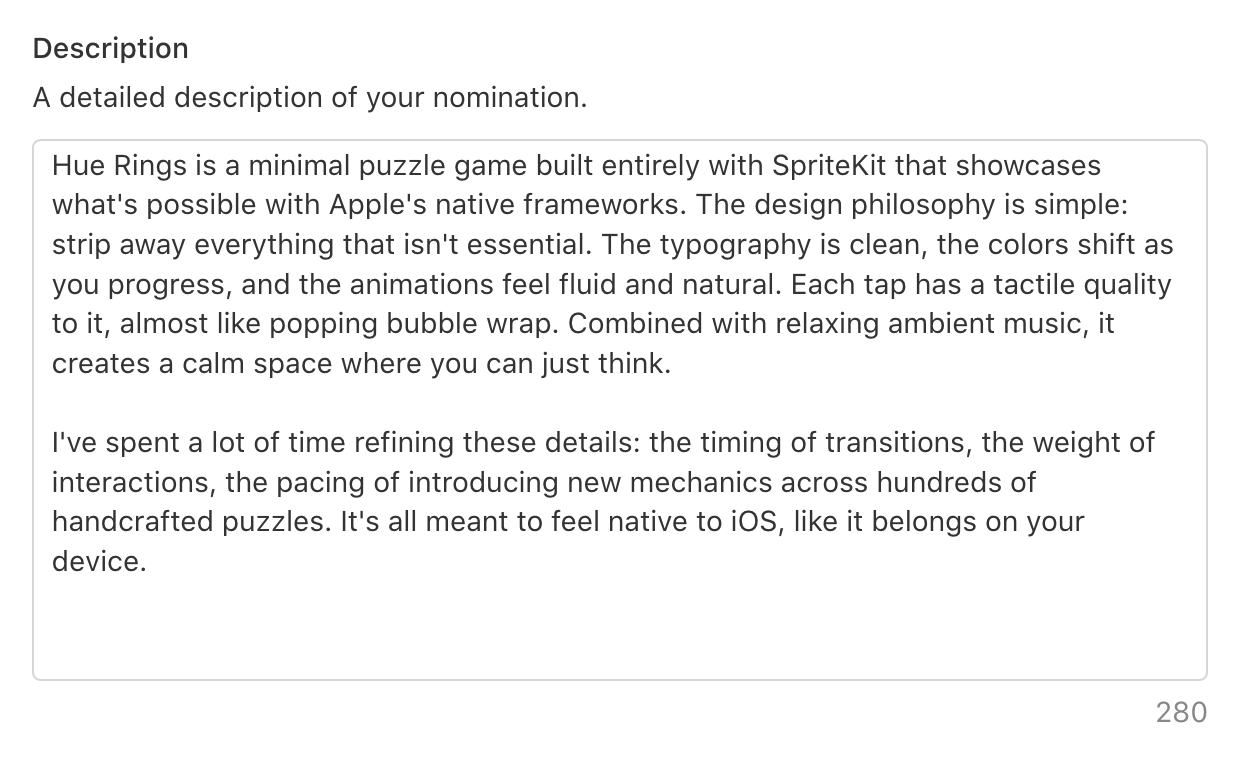
I did not expect it would get picked up at all, but I sent the nomination anyway in mid-February for a release date of mid-March. I ended up launching slightly earlier in March as a free game.
To my surprise, it did get picked up in New Games We Love across 139 countries. It was not featured in the US, which is where most of the revenue ideally would have come from, but it remained featured in various regions for eight weeks.
It also appeared on the Today page in Russia under a similar category with an Editor’s Choice badge. It is still featured today in India under the “Hidden Gems” section on the Games page.
Here are the numbers from App Store Connect after the feature:
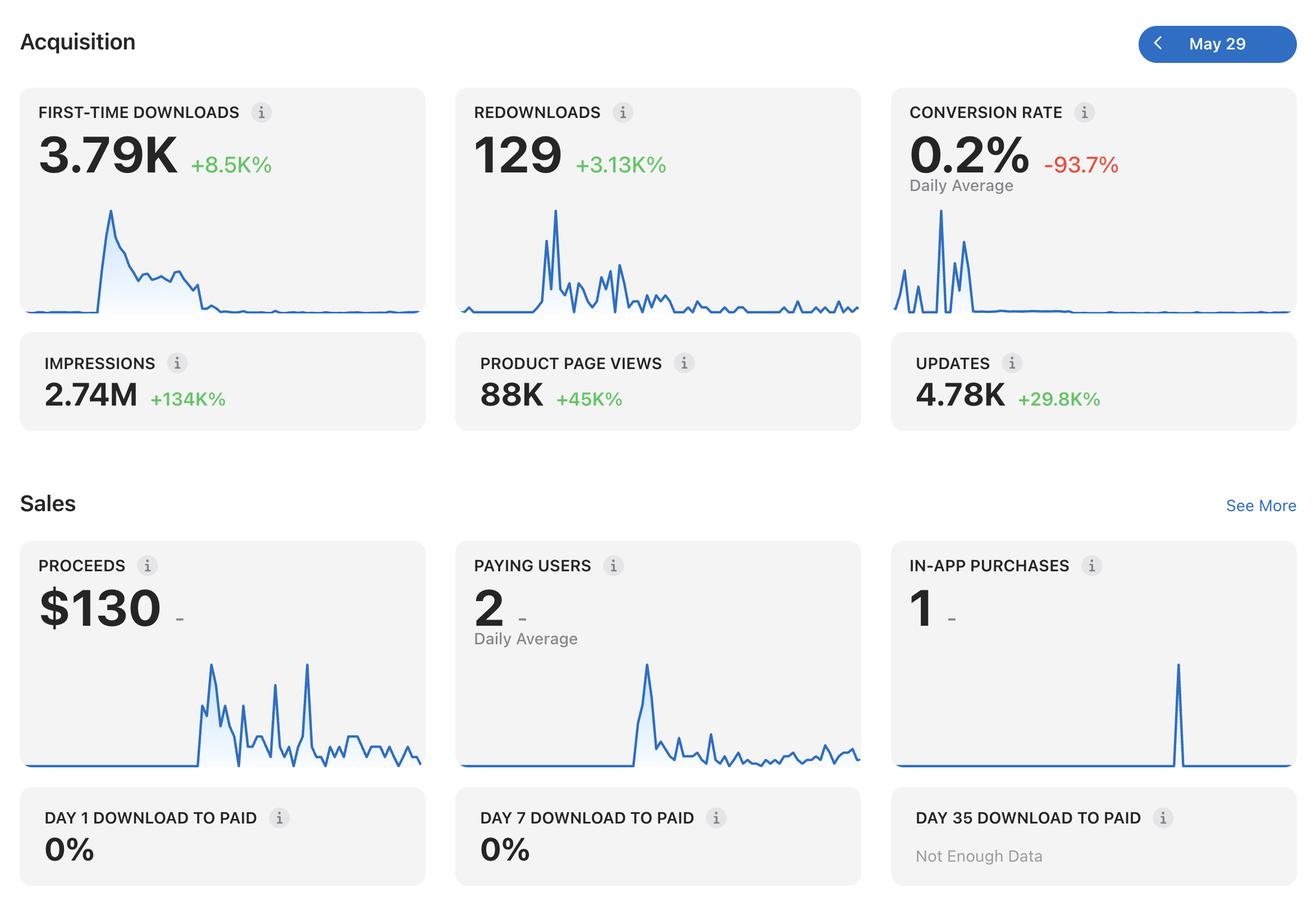
The feature gave the game far more visibility than I could ever have generated myself. But it also exposed some pretty big monetization mistakes that I shouldn’t ideally repeat going forward.
When I launched the game, I added in-app purchases for packs containing hints and undos in case people got stuck on a level. The trouble is that if people are not invested enough in the game, they will not spend money on utilities. They will probably just close the app and play something else.
It would have made much more sense to sell content instead, such as additional level packs or a full-game unlock. Throughout the entire journey, only one user bought an IAP.
I initially launched the game for free because I assumed that getting as many downloads as possible would be useful. It did result in downloads, but the downloads never translated to revenue.
I only started making money after switching to a paymium model. I changed the price to $0.99, with a lower price of around $0.29 in some countries, which resulted in the downloads dropping by a lot, but at least every user was a paid user.
For the kinds of small, niche puzzle games I like to build, charging a small upfront price seems to make more sense than trying to monetize a large number of free users.
I also experimented with rewarded ads through AdMob (I’m not a big fan of interstitial ads). Many people, especially those in Europe take their privacy seriously. Once you integrate AdMob though, the privacy of your app goes out the window.
The revenue was not worth the trade-off anyway. I made only around $2–4 from ads over several months, and AdMob has a $100 cutoff before they pay you a dime.
Running ads only makes sense if your game has a high enough LTV per user. For small, niche experiences like the ones I enjoy building, paid acquisition is probably worthless. At $1 eCPM, the conversion rate of 0.2% means that I must have a LTV of at least $0.50 to break even. While this seems possible, the conversion rate would be much lower if we account for the fact that we’d be pulling people out of their usual intent (scrolling Instagram for example). And $15-20 is normally the price you must pay for a 1000 views.
That does not mean the feature was useless. I am glad Apple picked up the game. It gave me a lot of useful data and made the mistakes much more obvious. But visibility alone does not solve monetization.
I am continuing to build small games, but I am keeping the business model much simpler going forward. My next game, Zyl, is now available for pre-order on the App Store.
It is another minimal puzzle game, this time built around placing arrows on a board, pressing play, and watching the route unfold. The lessons from Hue Rings directly shaped how I am releasing it. It is a premium game, with no ads, no IAPs, and no data collection, except for crash logs through Sentry.
Zyl launches soon on iPhone and iPad. You can pre-order it here:
 ZylPuzzleA minimal puzzle game about dropping arrows on a grid, routing paths to exits, and collecting every star along the way.
And if you would like to try Hue Rings:
 Hue RingsPuzzleEasy to learn, delightfully hard to master. Merge colorful rings in a beautifully minimal puzzle game.
Comments